Minimalist Wallpapers for Visual Calm in the Information Age
This article explains how minimalist wallpapers scientifically ease digital-age visual anxiety by reducing visual entropy, anchoring spatial perception, and regulating color psychology—offering practical, actionable steps to start your digital minimalism journey.
We absorb over 34GB of digital information daily—equivalent to reading 170,000 characters of text, watching 5 hours of video, and scrolling hundreds of times. This isn’t science fiction: it’s real behavioral data from Pew Research Center’s 2024 tracking study of adult digital users. Even more striking, nearly 68% of all visual stimulation comes from screen interfaces: pop-ups, notification bars, explosively colorful app icons, animated ads, and red message badges. Our retinas have become toll booths on an information superhighway—while our brains never received a ‘traffic limit’ notice.
This constant visual overload is quietly fueling a new kind of anxiety—Visual Anxiety: not triggered by any single event, but rooted in background-level sensory saturation. You may not know why you’re exhausted—but when you close your laptop, your eyelids feel heavy, your pupils tremble faintly, and your focus feels scoured raw by sandpaper. That’s your visual system sending an SOS.
Psychological research has long shown that the human prefrontal cortex has extremely limited bandwidth for processing visual input. A 2022 fMRI study published in Nature Human Behaviour by UC San Diego revealed that when participants viewed high-complexity desktop interfaces (cluttered icons, stark contrast, dynamic elements), blood-oxygen levels in their dorsolateral prefrontal cortex (DLPFC)—a region critical for cognitive control and emotional regulation—remained elevated for up to 19 minutes. In other words, a flashy desktop silently drains the neural resources you need to calm down.
At this moment, a minimalist wallpaper isn’t just decoration—it’s a gentle act of visual subtraction. It doesn’t promise to solve the world’s problems, but it can reset the starting point of your sensory boundaries.
Why ‘Less’ Is Actually More Powerful
Minimalism is often mistaken for ‘emptiness.’ True minimalism, however, is intentional emptiness—rooted in the Japanese aesthetic concept of Ma (negative space): space isn’t absence, but breathing room; silence isn’t vacuum, but fertile ground for meaning.
Neuroscientist David Eagleman reveals in The Hidden Reality that roughly 30% of the human cortex is dedicated to vision—but up to 70% of visual input doesn’t come from the eyes at all. Instead, it’s generated internally by the brain’s predictive models. What we ‘see’ goes far beyond pixels on screen: it’s the brain actively filling in what it expects to see, based on past experience. A cluttered wallpaper triggers constant prediction checks: Does that color patch signal a new notification? Does that gradient hint at unread messages? Is that blurry edge a hidden menu? Each check is a tiny cognitive labor.
A truly minimalist wallpaper—like a low-saturation gray gradient, a subtle monochrome texture, or a composition with just one soft horizontal line—dramatically reduces prediction error. The brain stops straining to interpret; the visual cortex shifts from ‘alert mode’ to ‘rest mode.’ A 2023 eye-tracking study at the University of Tokyo confirmed that participants using solid-color + soft-glow wallpapers showed a 22% reduction in blink frequency after 90 minutes of continuous work—and a 41% improvement in subjective fatigue (VAS) scores.
Three Stress-Relief Mechanisms of Minimalist Wallpapers
1. Lowering Visual Entropy In information theory, ‘entropy’ measures disorder. High-entropy images—such as desktops flooded with icons, neon wallpapers, and flickering widgets—force the visual system to constantly re-anchor its focus, triggering orienting stress responses. Minimalist wallpapers reduce visual entropy by unifying brightness, limiting colors to ≤3 adjacent hues, and eliminating high-frequency textures—bringing visual load within the body’s physiological comfort threshold. This isn’t ‘boring’—it’s creating cognitive buffer space for attention.
2. Anchoring Spatial Awareness Anxiety often brings a sensation of ‘weightlessness’: thoughts scatter, time blurs, bodily boundaries soften. A minimalist wallpaper with a clear horizontal line, gentle light transitions, or subtle depth cues (e.g., hazy mountain silhouettes against softly blurred grass) activates the posterior parietal cortex (PPC)—the brain region integrating vision and bodily awareness to reaffirm ‘Where am I?’ That’s why users report: “After switching to the misty hillside wallpaper, my screen finally felt like a quiet window—not a glowing wall.”
3. Resetting Chromatic Psychology Modern UIs rely heavily on high-saturation blue light (shortest wavelength, strongest penetration), which boosts readability but suppresses melatonin and strains eye muscles. Minimalist wallpapers favor earthy tones (terracotta brown, oat white, moss gray) or low-stimulation cool tones (glacial blue, quartz purple)—colors clustered near the center of the ‘psychological comfort ellipse’ on the CIE 1931 chromaticity diagram. They don’t compete for attention—yet they quietly neutralize the screen’s inherent cold light, forming an invisible visual buffer layer.
How to Choose a Truly Effective Minimalist Wallpaper—Avoid These Three Subtle Traps
- ❌ The ‘Pseudo-Minimal’ Trap: Looks clean at first glance—but hides high-contrast watermark text, razor-sharp micro-geometric lines, or oversharpened ‘ultra-HD details.’ Real minimalism honors blur and transition—like outlines softened by morning mist.
- ❌ The ‘Feature Hijack’ Trap: Wallpapers embedding calendars, weather widgets, or to-do lists. Minimalism’s core is reclaiming control—not replacing one layer of information with another form of visual anxiety.
- ❌ The ‘Emotional Mismatch’ Trap: Using icy metallic gray during late-night work sessions—or jarring lemon yellow during depressive lows. Minimalism needs warmth. Try versions with gentle natural textures: fine paper grain, water-diffused edges, or wool-felt tactility—so ‘less’ feels breathable and touchable.
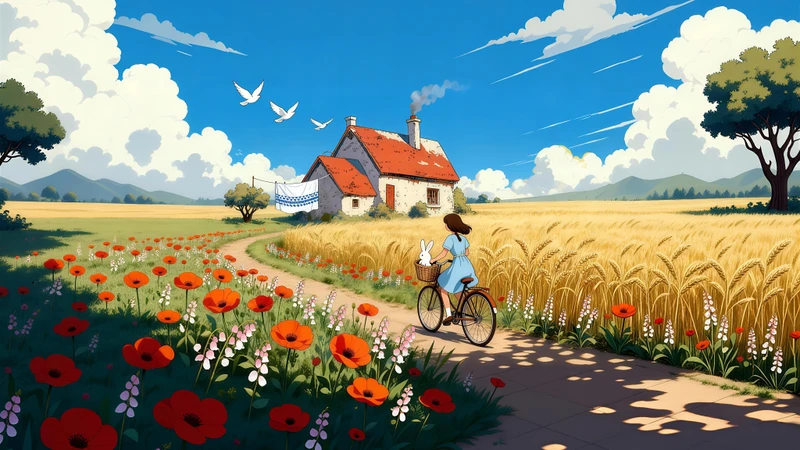
Note: Minimalism ≠ monotony. Consider Flower Field Dwelling, a standout piece from WallpaperSense’s Countryside Cottage 8K Ultra HD Wallpaper Pack. It embodies ‘warm minimalism’: no intricate flower close-ups—just a humble cottage seen from a low angle, bathed in soft light amid vast fields of pale pink-and-white blooms. Its palette stays tightly unified within a springtime low-saturation range; detail-rich yet unobtrusive—8K resolution preserves petal fuzz and brick-grout texture when zoomed, while the overall mood remains serene and poetic. It doesn’t offer escape—it invites presence: you needn’t be the protagonist of the scene to dwell peacefully within it.
Starting Digital Minimalism—with Your Wallpaper
Changing your wallpaper is the lightest—and most ritualistic—entry point into digital minimalism. It requires no app uninstallation, no social obligation negotiation, no rejection of technology’s value. It’s simply turning the first knob of your visual environment.
Try this:
- Tonight before shutting down, spend 2 minutes removing all animated wallpapers and widgets;
- Tomorrow morning, set a wallpaper with no text, no logo, and no more than two dominant colors (choose from natural-light photography, monochrome watercolor, or macro textile textures);
- For three consecutive days, notice whether your first breath upon opening your laptop feels deeper, slower.
You might discover: when your screen stops demanding your attention, you begin choosing—gently and willingly—to rest your gaze longer: on the pause before an unread email, on the stillness after finishing a paragraph, on a sudden, shimmering idea unrelated to productivity.
In an age where information never powers down, true calm may not come from blocking the world—but from reserving, within the square inch of your screen, a quiet expanse of unclaimed white space. No to-do lists. No read receipts. Just light. Shadow. And the possibility of recognizing yourself again.
Related Articles
Nature Scenery Wallpapers for Stress Relief at Work
How nature scenery wallpapers lower stress at work — with practical steps, scien...
How to Choose Deep Work Wallpapers: A Step-by-Step Guide
A practical, step-by-step guide to choosing wallpapers that reduce distraction a...
Blue Wallpaper Calm: How Ocean Tones Quiet Your Mind
How ocean-tone blue wallpapers reduce stress and sharpen focus—backed by color p...