How Nature Wallpapers Help Your Brain Pause: The Science of Attention Restoration
Based on Attention Restoration Theory (ART), this article explains how nature wallpapers scientifically reduce cognitive fatigue for professionals, boost focus, and strengthen emotional resilience—featuring two high-quality wallpaper packs designed with psychological principles.
Have you ever experienced an afternoon like this: after staring at your screen for two hours, your eyes feel dry, your thoughts sluggish—even rereading a simple email three times? This isn’t laziness or lack of ability. It’s your brain sounding the alarm for ‘attention depletion.’ Modern office environments continuously drain our directed attention—the cognitive resource that requires self-control and filtering out distractions, and it’s profoundly limited. Yet a psychology-backed theory, validated for nearly 40 years, quietly offers a solution: Attention Restoration Theory (ART).
ART was systematically developed in 1989 by environmental psychologists Rachel Kaplan and Stephen Kaplan. They found that when people are immersed in certain natural settings—like forest trails, quiet lakeshores, or mist-shrouded mountains—they enter a state of effortless engagement. This activates involuntary attention: it demands no willpower and gently recharges fatigued neural pathways. Crucially, restorative natural scenes share four core qualities: Being-away (psychological detachment from daily stressors), Extent (spatial or narrative depth that invites imagination), Fascination (inherent appeal through color, texture, and light), and Compatibility (effortless perceptual flow—no need to ‘decode’ the scene). Together, these create ‘soft fascination’: a gentle, sustained draw that allows the overworked prefrontal cortex to rest.
Remarkably, ART doesn’t require stepping into a real forest. A 2015 University of Michigan controlled study showed that participants who replaced their desktop wallpaper with high-resolution nature imagery for five consecutive days improved attention network test (ANT) accuracy by 19% and reported 32% less fatigue—matching the restorative effect of a 20-minute outdoor walk. Why? Because high-fidelity natural images still trigger the brain’s limbic ‘safety signal’: smooth curves, balanced cool-warm tones (e.g., sage green + soft white), and low-contrast transitions suppress amygdala hyperactivity and reduce cortisol secretion. In short, a well-designed wallpaper functions as a micro ecological healing space.
So what makes a nature wallpaper truly ART-aligned? First, avoid ‘information overload’: cluttered travel photos, oversaturated filters, or jarring cut-out elements force the brain back into directed attention—counteracting restoration. Ideal choices embody East Asian aesthetics of ‘negative space’—distant misty mountains, a lone pine in fog, or water reflections—giving the eyes visual breathing room. Second, prioritize ‘dynamic stillness’: gently rippling lake surfaces, swaying bamboo shadows, or slowly drifting mountain mist satisfy fascination without inducing anxiety. Third, resolution must precisely match your device—blurry or stretched images trigger subconscious discomfort and break restorative immersion.
We recommend two ART-optimized wallpaper packs: ‘Soothing Miyazaki Landscape Wallpaper’ captures the gentle light and hand-drawn warmth of Studio Ghibli films, evoking the fairy-tale healing of forest streams and valleys. ‘Japanese Landscape 8K Ultra HD Desktop Wallpaper Pack’ goes further—a dual-image set featuring the crystalline stillness of an Alpine glacial lake mirroring snow-capped peaks, and the rhythmic flow of layered waterfalls in a mist-laced valley. Both use true 8K resolution and native aspect ratios for seamless, uncropped immersion on Mac, iPad, and Windows desktops. These aren’t merely ‘pretty’—they translate ART’s four principles into pixel-perfect language: psychological distance from urban rhythm, mental extension of mood, low-intensity fascination to spark involuntary attention, and Eastern compositional harmony for cognitive compatibility.
Of course, wallpaper is just the starting point. Real restoration comes from ‘perceptual awakening’: when you install a new wallpaper, pause for 10 seconds and truly observe—the way light fractures across water, how moss creeps up stone steps, how cloud shadows glide slowly along ridges. This small act of intentional looking marks the shift from passive ‘seeing’ to active ‘perceiving.’ Neuroscience confirms that just 90 seconds of focused natural observation significantly stabilizes heart rate variability (HRV) and strengthens parasympathetic tone. You don’t need to escape work—you just need a window to restoration, right on your screen.
One final note: ART isn’t a cure-all, but it is a scientifically robust ‘cognitive cushion.’ When KPIs and meetings dominate your calendar, remember—the mountains and rivers on your desktop aren’t just decoration. They’re your brain’s quiet, authorized pause. Next time your focus feels like sand slipping through an hourglass, skip the third cup of coffee. Try turning your screen into a breath-ready forest instead. Your prefrontal cortex is waiting—for silent, steady spring rain.
Recommended Wallpaper Packs
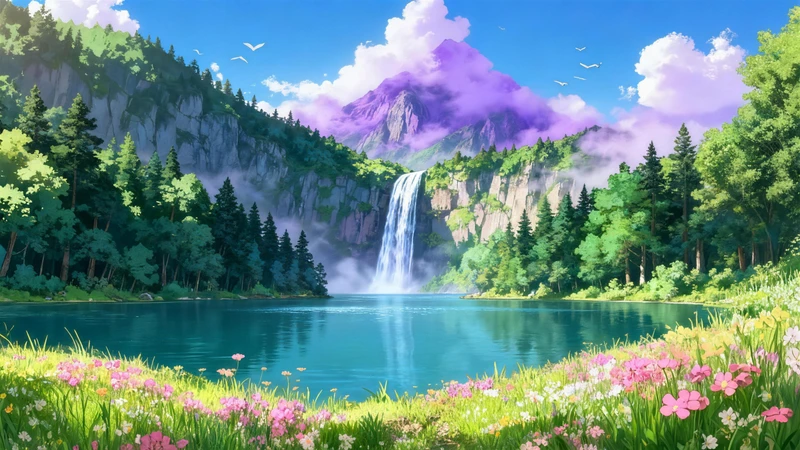
Japanese Landscape 8K Ultra HD Desktop Wallpaper Pack
Two Japanese landscape wallpapers in 8K ultra HD resolution, optimized for desktop displays to evoke calm and healing tranquility.
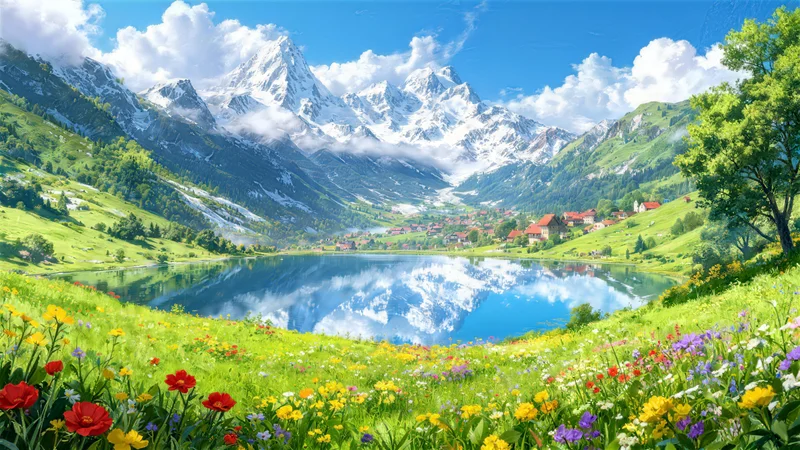
Soothing Miyazaki Landscape Wallpaper - 4K/8K Ultra HD for Mac, iPad & Tablet Desktop
Soothing Miyazaki Landscape Wallpaper - 4K/8K Ultra HD for Mac, iPad & Tablet Desktop
Related Articles
Nature Scenery Wallpapers for Stress Relief at Work
How nature scenery wallpapers lower stress at work — with practical steps, scien...
How to Choose Deep Work Wallpapers: A Step-by-Step Guide
A practical, step-by-step guide to choosing wallpapers that reduce distraction a...
Blue Wallpaper Calm: How Ocean Tones Quiet Your Mind
How ocean-tone blue wallpapers reduce stress and sharpen focus—backed by color p...