Miten vesipohjaiset taustat lievittävät ahdistusta: tieteellisesti tuettu visuaalinen rentoutumistapa
Miksi vesiteemaiset taustat lievittävät ahdistusta? Tämä artikkeli selittää, miten vesikuvien visuaaliset rytmit säätävät autonomista hermostoa neurotieteiden ja suunnittelupsykologian avulla – sekä tarjoaa käytännönläheisen valintaohjeen että toimintavinkkejä.
Have you ever caught yourself staring at the gently rippling lake in the bottom-right corner of your screen during a late-night work session? Within seconds, your breathing deepens and your tense shoulders soften—this is no coincidence. Growing neuroscience and environmental psychology research confirms that visual representations of water—raindrops sliding down glass, soft ocean waves, mountain streams—directly regulate the autonomic nervous system: lowering cortisol levels and boosting parasympathetic activity. This 'visual hydrotherapy' requires no headphones, no time investment—just a thoughtfully designed water-themed wallpaper to quietly build a miniature sanctuary of calm on the screen you interact with dozens of times each day.
Water’s calming power is rooted in human evolution. Our ancestors depended on water for survival, so our brains developed a deep-seated preference for its visual hallmarks: flow, reflection, transparency, and soft boundaries. A 2019 fMRI study published in Environment and Behavior found that when participants viewed static lake imagery, prefrontal cortex activity decreased while the insula and anterior cingulate cortex—regions tied to emotional regulation—showed more synchronized low-frequency oscillations. This is a hallmark signal of the brain entering the 'default mode network' (DMN), shifting from task-focused thinking to self-repair and integration. Remarkably, this effect remained strong even without sound—proving that visual waterscapes alone activate an independent calming pathway.
When vision and sound work together, the effect amplifies. Classic research shows that white noise in the 40–70 Hz range—like gentle rain or lapping waves—can suppress amygdala overactivity. But in reality, we can’t always play nature sounds—especially in offices or shared spaces. That’s where high-fidelity water wallpapers step in as a 'silent soundscape alternative.' Through compositional rhythm (e.g., repeating wave arcs), color cadence (cool-toned gradients of blue, teal, and gray), and textural nuance (subtle light-dark transitions in ripples), they send 'safe, predictable, non-threatening' signals to the visual cortex—indirectly quieting stress circuits. Designers call this 'visual rhythm': a silent metronome that gently realigns scattered attention with natural breathing patterns.
Not all 'water wallpapers' deliver equal restorative value. Low-resolution images cause visual fatigue; overly dynamic scenes—like crashing waves—may trigger alertness; and purely abstract water patterns lacking realistic texture fail to activate our evolved biophilic response. Truly effective water wallpapers meet three criteria: first, spatial depth (e.g., distant mountains mirrored in still water, reinforcing a sense of 'habitable safety'); second, subtle motion cues (even in static images—light direction and ripple orientation should imply gentle, ongoing flow); and third, restrained color temperature (avoiding saturated blues; instead favoring low-chroma, high-value hues like misty teal, porcelain white, and slate blue—mimicking naturally diffused light on water).
For a scientifically grounded yet aesthetically refined example, try the 'Alps Snowy Peaks Lake Scenery 8K Wallpaper Pack.' It features no roaring coastline—but a serene high-altitude lake, its surface mirror-still yet alive: faint ripples trace the wind’s passage, ice crystals glint with cool clarity along snow-ridged peaks, and sky-light bleeds softly into pale aqua at the lake’s center. Its 8K resolution renders every ripple texture tactile and true—not harsh or straining. The wide aspect ratio delivers immersive scale without visual pressure. Users report: 'After setting it as my desktop, two minutes of gazing leaves my mind feeling rinsed clean by lake water'—a direct result of visual rhythm harmonizing with natural water tones. It doesn’t force relaxation; it gently carves out space for pause.
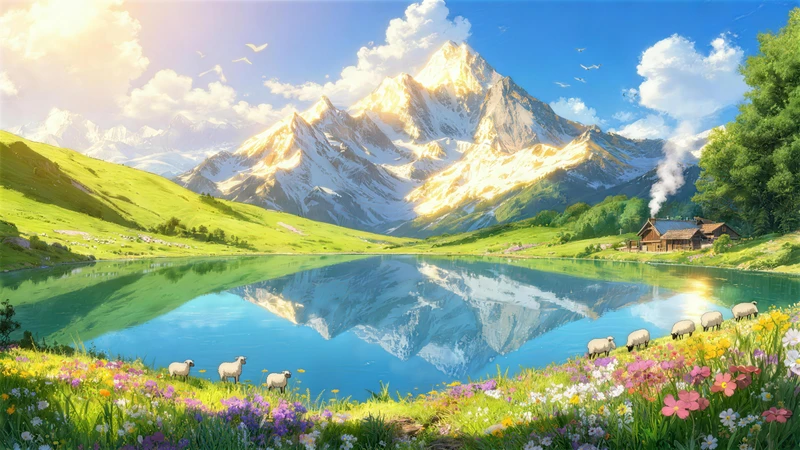
Of course, wallpaper is just the entry point. Use it as an 'attention anchor': when thoughts scatter, spend 15 seconds observing the symmetry of mountain reflections; or pair it with 4-7-8 breathing (inhale 4 sec → hold 7 sec → exhale 8 sec), letting your eyes follow ripples slowly left to right. These micro-rituals transform passive viewing into active sensory regulation. Japan’s 'forest bathing' (Shinrin-yoku) invites full-sensory immersion in nature—while water wallpaper offers the digital age’s most accessible 'desk bathing' (Desk-yoku). You don’t need to leave your workstation—just step briefly out of role, into a self that feels held, softened, and renewed by light on water.
Finally, remember: relaxation isn’t the opposite of productivity—it’s the foundation of sustainable focus. Neuroscientist Amishi Jha writes in Peak Mind: 'A brain under chronic high pressure functions like an overloaded server—it needs regular reboots, not more commands.' A well-designed water wallpaper is your daily, miniature system reboot. It won’t solve your tasks—but it restores your capacity to solve them. Next time your chest tightens or your thoughts stall, don’t rush to refresh your inbox. First, look at the water on your screen. It’s been there all along—quiet, clear, waiting for you to recognize your own innate frequency of calm.
Related Articles
Nature Scenery Wallpapers for Stress Relief at Work
How nature scenery wallpapers lower stress at work — with practical steps, scien...
How to Choose Deep Work Wallpapers: A Step-by-Step Guide
A practical, step-by-step guide to choosing wallpapers that reduce distraction a...
Blue Wallpaper Calm: How Ocean Tones Quiet Your Mind
How ocean-tone blue wallpapers reduce stress and sharpen focus—backed by color p...