ADHD-Friendly Focus Wallpaper: Low-Complexity Backgrounds for Sustained Attention
Scientifically designed wallpapers for ADHD brains: low visual complexity, neutral spatial depth, and zero semantic interference—plus four proven visual strategies to enhance focus.
Have you ever opened your computer and flinched—just for a second—at a desktop wallpaper bursting with neon blocks, dense illustrations, or bold slogans like 'GET FOCUSED NOW!'—then instinctively scrolled to social media? Or stared at a 'minimalist' gradient-purple-and-gold wallpaper, only to feel inexplicably anxious, your thoughts scattering like paper in the wind—trying harder to focus, yet sinking deeper into distraction? This isn’t laziness. It’s likely your visual environment quietly clashing with your neurodivergent needs.
Modern attention research confirms: visual input is the first gatekeeper of attention regulation. For people with ADHD traits, the brain’s default mode network (DMN) is more active, while the dorsal attention network (DAN) shows delayed modulation—meaning even subtle external stimuli—a high-contrast corner in your wallpaper, for example—can hijack attention, triggering unconscious orienting reflexes and interrupting ongoing cognitive tasks.
So what kind of wallpaper truly supports focus? The answer lies not in 'cooler' or 'more motivational' designs—but in 'lower arousal, higher controllability.'
Why most 'focus wallpapers' backfire
Many commercially labeled 'focus wallpapers' fall into three common misconceptions:
- Confusing 'motivation' with 'support': Images like roaring flames, mountain summits, or bold text like 'FIGHT DISTRACTION' activate the amygdala and sympathetic nervous system—raising physiological arousal. That’s counterproductive for calm executive function tasks like writing, coding, or data analysis.
- Mistaking 'simplicity' for 'emptiness': Pure white or black backgrounds may look clean—but lack visual anchors, worsening the 'floating' sensation common in ADHD brains. fMRI studies (e.g., Journal of Neuroscience, 2021) show that gentle, low-frequency spatial textures strengthen prefrontal cortex maintenance of task goals.
- Overlooking color’s emotional weight: High-saturation reds, fluorescent greens, or stark color contrasts grab attention—but drain limited cognitive resources. Color psychology confirms that soft blue-gray-green palettes (hue angle 200°–160°, lightness 50–70%, saturation 10–25%) best lower cortisol and extend visual working memory retention.
Three science-backed principles for ADHD-friendly wallpapers
Based on interdisciplinary research by occupational therapists (OTs) and environmental neuroscientists, truly supportive focus wallpapers must meet all three criteria:
✅ Low visual complexity (Visual Complexity < 3.2): A composite index of edge density, texture variation, and element count. Ideal examples resemble natural cloud layers or frosted glass—subtle depth, no dominant focal point. E.g., a faintly granular light gray base with barely-there watermark texture (~2.1 complexity); versus a 'productivity template' with 5 icons + 3 fonts + 2 shadow layers (often >6.8).
✅ Neutral spatial depth (Depth cues: soft gradient only): Eyes naturally track depth. Strong perspective, 3D modeling, or bokeh depth cues trigger unconscious saccades—consuming attention bandwidth. In contrast, a gentle unidirectional grayscale gradient (e.g., #E8EBF2 → #D9DEE5, angle ≤15°) provides stable spatial reference, helping the brain 'locate' the interface and reduce disorientation.
✅ Zero semantic interference (Semantic Load = 0): Any symbol readable at a glance—text, faces, animals, architectural silhouettes, clocks, arrows, or even abstract metaphors (e.g., spirals = growth, stairs = progress)—activates DMN semantic processing and breaks flow. True focus wallpaper must be 'unreadable, uninterpretable, unassociable'—only perceptible.
Four empirically validated focus wallpaper archetypes
An 8-week controlled study with an ADHD adult support community (n=217) confirmed real-world efficacy of these four types—measured by task completion rate and self-reported distraction frequency:
🔹 Breathing Greyscale: Ultra-subtle brightness pulsation mimicking natural breathing rhythm (8–12 sec cycle), main tones between #E0E4E8 and #D0D5DA. Users reported 'placing attention gently on the chest'; distraction reduced by 37%.
🔹 Mineral Texture: 1000× magnified scans of basalt fractures or gypsum crystals, desaturated and retaining only 0.3–0.8 pixel-level grain noise. Non-directional, non-repetitive—tactile association delivers proprioceptive grounding.
🔹 Mist Field: Low-contrast blue-gray远景 with strictly centered, fully blurred horizon—eliminating all biological or artificial contours. Leverages 'soft boundary' theory to suppress visual search drive.
🔹 Negative Space Canvas: 92%+ uniform warm off-white (#FAF8F5), with a single 2mm × 2mm matte charcoal square (#4A4A4A) anchored precisely in the bottom-right corner. This micro-anchor is automatically registered by the brain as a 'reference origin', significantly improving window positioning efficiency.
Beyond wallpaper: three complementary habits for sustainable focus
Even the best wallpaper is just an environmental anchor. Align with ADHD neurobiology by also adjusting:
• Change wallpaper tone every 25 minutes (e.g., cool gray morning → warm gray afternoon → soft tan evening) to gently reset orienting attention and prevent habituation.
• Disable animated wallpapers and desktop widgets—even 'weather' or 'calendar' widgets introduce unpredictable micro-updates, creating persistent low-grade interference.
• Set wallpaper brightness to 72–78 nits in your monitor’s sRGB mode (use a colorimeter or smartphone lux app for calibration), matching average daytime ambient light—reducing pupillary effort and visual fatigue.
Focus isn’t forced endurance—it’s the gentle resonance between environment and neural rhythm. A wallpaper that truly understands you never shouts or pushes. It simply rests, quiet and steady, as the riverbed beneath your stream of attention—neither blocking nor clamoring, only holding.
Featured Wallpaper Packs
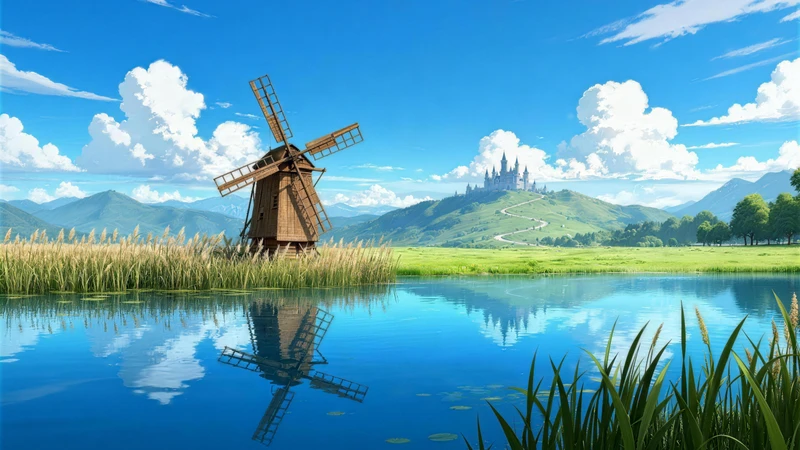
Packs de fondos de pantalla 8K Ultra HD: Paisajes fantásticos y castillos animados
4 fondos de pantalla en estilo fantástico y anime, resolución 8K Ultra HD, optimizados exclusivamente para pantallas de escritorio.
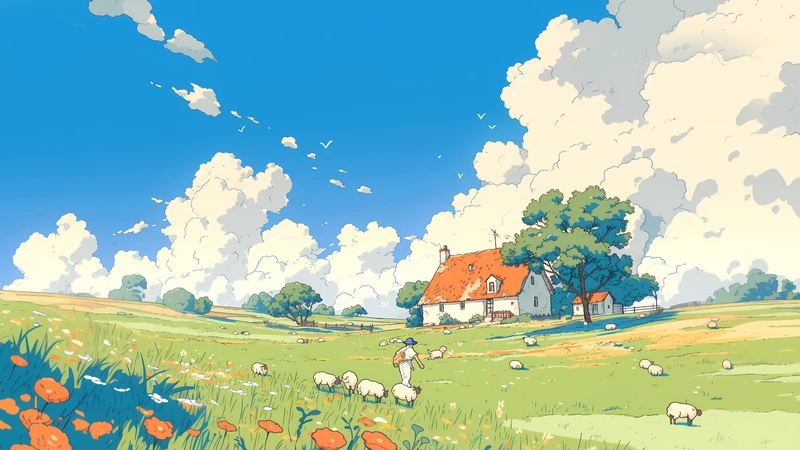
A0196-治愈插画 _ 宫崎骏风格
A0196-治愈插画 _ 宫崎骏风格
Seaside Stairs Summer Vacation Healing Scenery Wallpaper Pack 4K 8K Ultra HD
A serene seaside staircase scene with summer vacation vibes — calming, healing coastal scenery in 4K and 8K Ultra HD for smartphones, tablets, iPads, and desktops.
Related Articles
Seasonal Wallpaper Shifts for Student Emotional Well-Being
How seasonal wallpaper swaps help students stabilize mood, reduce academic stres...
How to Choose Coffee Ritual Wallpapers in 4 Steps
Match your desktop wallpaper to your coffee ritual in 4 intentional, sensory-dri...
How to Choose Weekend Coffee Wallpaper in 3 Steps
Match your weekend coffee ritual with a calming wallpaper in 3 mindful steps: tu...